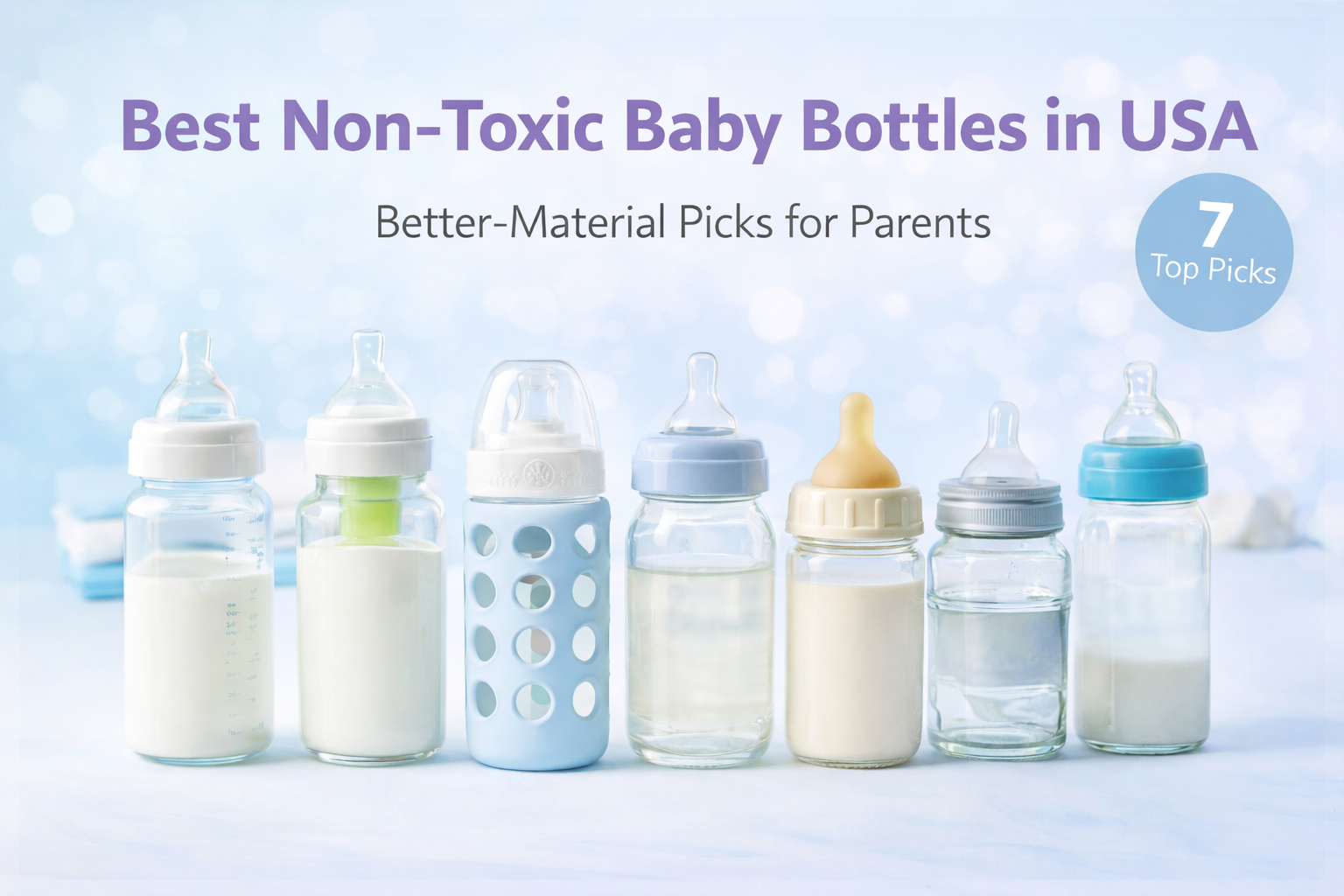
Most baby bottles sold in the U.S. are already BPA-free. FDA regulations no longer provide for the use of BPA-based polycarbonate resins in baby bottles and sippy cups. That regulatory change followed evidence that this use had already been abandoned by manufacturers. So when parents search for a "non-toxic baby bottle," they usually want something beyond that baseline: glass instead of a plastic bottle body, fewer plastic-contact points, or clearer manufacturer disclosure about the materials used in each component. This article is for informational purposes only and is not medical advice.
Our Top Picks at a Glance
Philips Avent Glass Natural Response — Best overall glass bottle. Dr. Brown's Options+ Glass — Best anti-colic glass bottle. Chicco Duo — Best hybrid bottle. Lifefactory — Best glass with sleeve. HEVEA — Best eco-leaning pick. Mason Bottle — Best for storage-minded parents. Evenflo Balance+ Glass — Best value glass option.
Quick Comparison Table
| Brand | Material | Best for | Anti-colic | BPA-free |
|---|---|---|---|---|
| Philips Avent Glass Natural Response | Glass | Best overall glass bottle | — | ✅ |
| Dr. Brown's Options+ Glass | Glass | Best anti-colic glass bottle | ✅ Internal vent | ✅ |
| Chicco Duo | Glass + plastic hybrid | Best hybrid bottle | — | ✅ |
| Lifefactory | Borosilicate glass | Best glass with sleeve | — | ✅ |
| HEVEA | Borosilicate glass | Best eco-leaning pick | — | ✅ |
| Mason Bottle | Glass (mason jar) | Best for storage-minded parents | — | ✅ |
| Evenflo Balance+ Glass | Glass | Best value glass option | ✅ One-piece vent | ✅ |
1. Philips Avent Glass Natural Response — Best Overall Glass Bottle
Philips Avent is a straightforward mainstream anchor for this list. Its Glass Natural Response bottle gives you the simplicity many parents want from glass, while still coming from a widely available brand with a familiar feeding system. Philips Avent's Glass Natural Response bottle uses a borosilicate-glass bottle body with BPA-free components, and it has a wide-neck design for easy filling and cleaning.
Some parents on Reddit describe Philips Avent's glass bottles as a simpler system that works well once the right nipple flow is dialed in, though they also note the Natural Response setup can feel slower-flow at first for some babies.
Best for: parents who want a mainstream glass bottle that feels straightforward, familiar, and easy to buy.
Watch out for: The Natural Response nipple can feel slower-flow at first — some babies take a feed or two to adjust, and parents sometimes need to try a faster nipple size.
2. Dr. Brown's Options+ Glass — Best Anti-Colic Glass Bottle
Dr. Brown's earns a spot because it brings a very clear anti-colic use case to the roundup. Dr. Brown's says its internal vent system is clinically proven to reduce colic and positions the bottle as helping reduce spit-up, burping and gas.
That lines up with what some parents mention in the linked Reddit discussion: Dr. Brown's often comes up when gas or colic is the main concern, but the tradeoff people mention most is the extra cleaning and parts.
Best for: parents who want a glass bottle with a stronger anti-colic angle.
Watch out for: The internal vent system means more parts to wash and assemble after every feed — a real factor for parents who value quick cleanup.
3. Chicco Duo — Best Hybrid Bottle
Chicco Duo is one of the most distinctive bottles in the category. It uses a pure glass inner layer bonded to a premium plastic outer layer, giving parents a "glass-on-the-inside" story without the same feel or fragility of a full glass bottle. Chicco says the glass inner layer and silicone nipple shield the milk from contact with the bottle's plastic exterior. Chicco says Duo is free of BPA, BPS, PVC, latex and phthalates.
Reddit parents often describe Chicco Duo as a smart compromise pick because it feels much lighter than full glass, and several specifically mention liking it for daycare situations where standard glass bottles are less practical.
Best for: parents who like the idea of glass contact on the inside but want a lighter, more durable-feeling bottle.
Watch out for: The hybrid construction means the outside is still plastic — parents who want full glass contact everywhere may prefer a pure glass bottle instead.
What parents mentioned in real use
Across Reddit discussions, parents most often compare baby bottles based on four things: gas relief, nipple flow preference, cleaning effort, and how heavy glass feels day to day.
- For anti-colic concerns, Dr. Brown's gets mentioned a lot, but so does the extra cleanup.
- Philips Avent is often seen as simpler, though more sensitive to nipple-flow preference.
- Chicco Duo gets brought up as a lightweight middle ground for parents who want glass contact inside without the feel of full glass.
4. Lifefactory Glass Baby Bottle — Best Glass Bottle with Sleeve
Lifefactory stands out because it pairs borosilicate glass with a protective silicone sleeve, which is a nice practical middle ground for parents who want glass but worry about grip and breakage. Lifefactory says its baby bottles use thermal-shock-resistant borosilicate glass with a protective silicone sleeve and are BPA-free and phthalate-free.
Best for: parents who want a more protected glass bottle for everyday handling.
5. HEVEA Glass Bottle — Best Eco-Leaning Pick
HEVEA is a strong fit for this topic because its material story is unusually clear. HEVEA uses a borosilicate-glass bottle body with a nipple made from natural rubber from the Hevea brasiliensis tree, and its screw caps and dust covers are polypropylene. The brand says its products are free of BPA, PVC, and phthalates.
Best for: parents who want a bottle with a more eco-leaning and natural-materials feel.
6. Mason Bottle — Best for Storage-Minded Parents
Mason Bottle brings a very different workflow to the list. Instead of looking like a conventional baby bottle system, it turns mason jars into baby bottles, which can appeal to parents who like multi-use glass containers and a more modular setup. Mason Bottle says its products have been extensively tested and are free of BPA, BPS, phthalates and lead. The glass-and-silicone feeding design can minimize direct milk contact with plastic, although some configurations include external plastic components.
Best for: parents who like the idea of using glass jars as part of a feeding and storage system.
7. Evenflo Balance+ Glass — Best Value Glass Option
Evenflo Balance+ Glass rounds out the list as a more accessible value play. Developed with pediatric feeding specialists, its glass version emphasizes thermal-shock-resistant bottles and a one-piece anti-colic vent. Evenflo says its one-piece integrated vent is designed to help prevent colic, gas and fussiness. Free of BPA, polycarbonates, PVC, and phthalates.
Best for: parents who want a glass bottle with a feeding-focused design without jumping to a higher premium tier.
How We Chose the Best Non-Toxic Baby Bottles
We looked at four things: (1) Material clarity — brands scored better when their official pages clearly explained what components were made from. (2) A distinct use case — each bottle has a clear role. (3) Mainstream or practical availability — we favored products with clear official U.S. product pages. (4) Parent-friendly construction choices — we focused on products that make concrete material claims.
We also compared official material disclosures side by side and weighed practical tradeoffs parents actually care about — cleaning effort, bottle weight, breakage anxiety, and how many parts you have to deal with at 2 a.m.
Final Verdict
- Choose Philips Avent Glass Natural Response if you want the simplest mainstream glass bottle with wide availability and easy cleanup.
- Choose Dr. Brown's Options+ Glass if gas, colic, or spit-up are your main concern and you do not mind extra parts to wash.
- Choose Chicco Duo if you want glass contact on the inside without the weight or breakage anxiety of a full glass bottle.
- Choose Lifefactory if you want borosilicate glass with a protective silicone sleeve for better grip and drop protection.
- Choose HEVEA if you want a more eco-leaning glass bottle with natural rubber nipples.
- Choose Mason Bottle if you like a modular glass system that doubles as storage.
- Choose Evenflo Balance+ Glass if you want a solid glass bottle with anti-colic venting at a lower price point.
Frequently Asked Questions
Which baby bottle material is best?
There is no single best material for every family. Glass is often the simplest choice for parents who want to minimize plastic contact with milk, while silicone can appeal to parents who want a softer, lighter bottle. Hybrid designs like Chicco Duo try to split the difference.
Are glass baby bottles better than plastic?
Neither glass nor plastic is automatically the best choice for every family. Glass bottle bodies can reduce milk's contact with plastic bottle walls, but glass is heavier and can break. Plastic bottles are lighter and more resistant to breakage. Nipples, collars, valves and caps may still contain silicone or plastic even when the bottle body is glass, so parents who care about material contact should look at the entire bottle system rather than the bottle body alone.
What does non-toxic baby bottle usually mean?
"Non-toxic baby bottle" is not a regulated product category. Parents commonly use the term when looking for features such as a glass or stainless-steel bottle body, fewer plastic food-contact surfaces, or manufacturer-confirmed exclusions such as BPA, BPS or certain phthalates. Those features should be evaluated individually rather than treating "non-toxic" as a certification.
What is the best non-toxic baby bottle in 2026?
Philips Avent Glass Natural Response is the best overall glass bottle. Dr. Brown's Options+ Glass is best for anti-colic needs. Chicco Duo is the most interesting hybrid option. Lifefactory, HEVEA, Mason Bottle, and Evenflo Balance+ Glass each serve distinct needs.
Is BPA still used in baby bottles in the USA?
FDA regulations no longer provide for the use of BPA-based polycarbonate resins in baby bottles and sippy cups in the U.S. The 2012 regulatory change reflected evidence that manufacturers had already abandoned that use. Parents looking at non-toxic bottles are typically interested in going beyond the BPA-free baseline to glass, silicone, or clearly labeled component-level transparency.
Do I need an anti-colic baby bottle?
Not every baby needs an anti-colic bottle. Anti-colic bottles use vents or other airflow-management designs intended to reduce the amount of air swallowed during feeding. Whether a particular design improves gas, spit-up or fussiness varies by baby. In this roundup, Dr. Brown's makes the strongest manufacturer-supported clinical claim: the company says its internal vent system is clinically proven to reduce colic.
Affiliate Disclosure
As an Amazon Associate, OriginSelect earns from qualifying purchases. When you click through our Amazon links (tag: store08291618-20), we may earn a commission at no extra cost to you. All external commerce links use rel="sponsored nofollow". Our recommendations are based on editorial research and values alignment—not commission rates.
Last updated: April 2, 2026