Quick answer
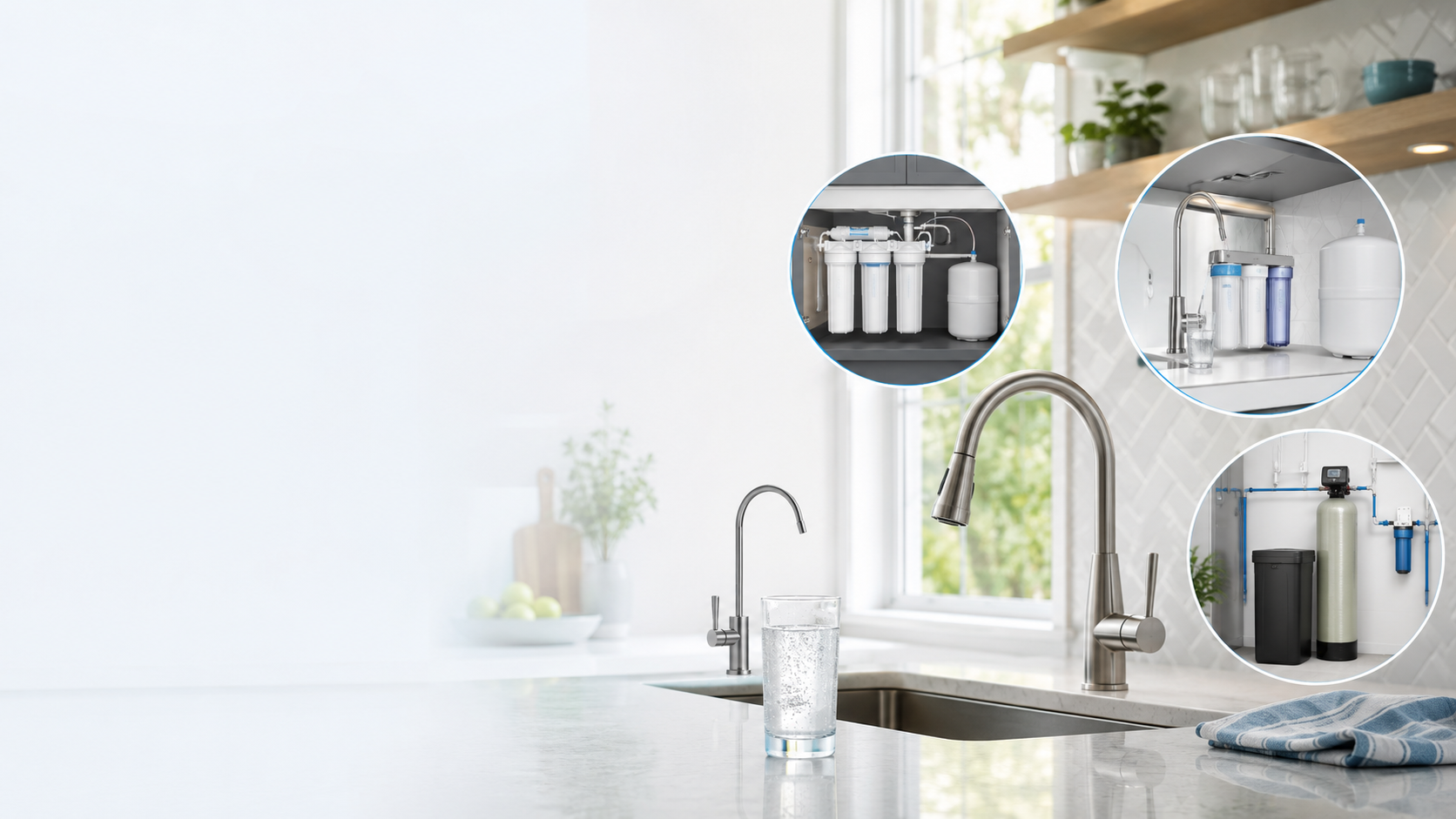
HomeWater's under-sink systems are for drinking and cooking water at one fixture; its reverse-osmosis option adds membrane-based treatment; UPSTREAM systems are installed at the main water line for whole-home concerns. Start with a water report or test, then match the system to the specific issue rather than choosing the most complex option by default.
HomeWater offers systems for several very different household needs: direct-connect under-sink filtration, reverse osmosis for one drinking-water fixture, whole-home filtration, and conventional water softening. The useful question is not which system has the most stages. It is which treatment method fits your water-quality results, plumbing, household size, and maintenance budget.
This guide is written primarily for US households. HomeWater currently says it ships to addresses in the United States and Canada; confirm delivery availability and any special-handling fee at checkout.
HomeWater options at a glance
The table summarizes published HomeWater information, not independent performance testing. Prices are the USD amounts displayed by HomeWater on July 28, 2026 and may change.
| Option | May suit | Installation | Listed price* |
|---|---|---|---|
| EZChange 2-Stage Under Counter Filter | Drinking and cooking water from an existing kitchen faucet | Under sink; connects to the existing faucet line | US$392 |
| EZChange 4-Stage + Alkaline Reverse Osmosis | Broader point-of-use treatment for drinking and cooking water | Under sink; dedicated drinking-water faucet | US$595 |
| UPSTREAM whole-home filter family | Water concerns that affect fixtures, showers, and appliances throughout a home | Main water line; professional installation may be appropriate | Call for pricing |
| UPSTREAM whole-home water softener | Hard-water scale, spotting, and soap-film concerns identified by testing | Main water line | US$1,995 displayed; call for pricing |
*Confirm the current price, currency, shipping, handling, and installation details before purchasing.
Explore current HomeWater options →

EZChange 2-Stage Under Counter Filter
US$392 displayed July 28, 2026
A direct-connect, under-sink option for drinking and cooking water from an existing kitchen faucet.
View the 2-Stage filter →
EZChange 4-Stage + Alkaline RO
US$595 displayed July 28, 2026
A dedicated-faucet, reverse-osmosis option for drinking and cooking water.
View the RO system →
UPSTREAM whole-home filters
Call HomeWater for current pricing
A main-water-line treatment family for concerns that affect water around the home.
View whole-home filters →
UPSTREAM whole-home water softener
US$1,995 displayed; call for current pricing
A separate hardness-treatment option for test-confirmed scale, spotting, and soap-film concerns.
View the water softener →Best fit for straightforward under-sink filtration: EZChange 2-Stage
The EZChange 2-Stage Under Counter Under Sink Water Filter is HomeWater's direct-connect option. HomeWater says it connects to the existing kitchen-faucet line, so it does not require a second faucet. The company lists a one-gallon-per-minute flow rate, 0.5-micron nominal filtration, and installation in as little as 15 minutes.
HomeWater lists this model as certified to NSF/ANSI 42, 53, and 372. Standard numbers alone do not establish every contaminant claim: NSF explains that 42 covers aesthetic effects such as chlorine, taste, and odor; 53 covers particular health-effect contaminants; and 372 concerns lead content in materials. Check the exact model's current certified-performance documentation for the contaminant you are concerned about.
Consider this option when
- You want to keep using your existing kitchen faucet.
- Your concern is limited to drinking and cooking water.
- You prefer a direct-connect under-sink setup over a storage tank and separate faucet.
- Your water report and the model's current documentation support the reduction claim you need.
What to consider: This is not a reverse-osmosis system. If a water report points to dissolved-water concerns that require membrane-based treatment, compare the exact certified claims rather than assuming a two-stage carbon system is interchangeable with RO.
See the HomeWater 2-Stage filter →
Best fit for a dedicated drinking-water faucet: EZChange 4-Stage + Alkaline RO
HomeWater's EZChange 4-Stage + Alkaline Reverse Osmosis Filtration System uses a sediment pre-filter, carbon pre-filter, reverse-osmosis membrane, carbon post-filter, alkaline filter, and a stainless-steel drinking-water faucet, according to the company.
Reverse osmosis can address some dissolved-water concerns, but the right choice depends on your water-quality results and the exact model's certified reduction claims. It also creates a reject-water stream. The EPA recommends considering water efficiency and looking for a WaterSense-labeled system where appropriate.
Consider this option when
- You want treatment focused on drinking and cooking water, not every fixture in the house.
- Your water report identifies a concern for which the exact RO system has current documented performance.
- You are comfortable dedicating under-sink space to a tank and adding a drinking-water faucet.
- You have budgeted for periodic filter and membrane maintenance.
Maintenance note: HomeWater's replacement-filter page recommends replacing the standard RO pre- and post-filter set every six to twelve months; the membrane is sold separately. Confirm the current schedule for the exact system you purchase.
Explore the HomeWater RO system →
Best fit for water concerns throughout the home: UPSTREAM whole-home filters
Whole-home, or point-of-entry, treatment is installed where water enters the house. It is relevant when the concern affects showers, faucets, laundry, appliances, or multiple fixtures—not only the kitchen sink.
HomeWater's UPSTREAM whole-home filter collection includes 300,000-gallon XS, one-million-gallon standard, and 1.5-million-gallon XL models, plus a well-water XL configuration. HomeWater describes the standard model for homes with roughly one to three people and the XL for larger households. Its listings describe the media and the concerns the systems are marketed to address; confirm the current performance documentation for any specific contaminant claim before buying.
Consider a whole-home filter when
- Water taste, odor, sediment, or other concerns affect more than one fixture.
- You want treatment before water reaches showers, laundry, and appliances.
- You are ready to evaluate main-line plumbing, flow needs, and professional installation.
- You want a system sized for the household rather than a single drinking-water tap.
What to consider: A whole-home filter and an under-sink RO system can perform complementary jobs. One treats water for the home generally; the other can provide more targeted treatment at a dedicated drinking-water fixture. Neither should be selected from a generic contaminant list without comparing it to your actual water results.
Explore HomeWater whole-home systems →
Do you need a filter, a softener, or both?
Water filtration and water softening are different treatments. A filter may target particular contaminants, sediment, or aesthetic concerns depending on its media and documented certification. A conventional ion-exchange softener is designed to address hardness minerals that contribute to scale, soap film, and spotting.
HomeWater's UPSTREAM Whole Home Water Softener is a 22,000-grain system. The company describes it as a whole-home solution for hardness-related concerns. If hardness is your question, use a water test to establish the level first; a softener does not automatically answer a separate filtration or drinking-water concern.
- Consider filtration first when your concern is about a documented contaminant, sediment, chlorine, taste, or odor.
- Consider softening first when testing confirms hard water and scale or spotting is the main concern.
- Consider both only when your water results support two distinct treatment needs.
- Consider under-sink RO when the treatment need is limited to drinking and cooking water.
View the HomeWater whole-home water softener →
How to choose a HomeWater system before you buy
1. Start with your actual water information
If you use a public water system, review your utility's Consumer Confidence Report. If you use a private well, use a state-certified laboratory because water conditions can vary from one property to another. A product page cannot diagnose what is in your water.
2. Match the treatment method to the problem
Point-of-use systems treat water at a fixture. Point-of-entry systems treat water as it enters the home. Reverse osmosis, carbon filtration, and softening each have different roles. A water report plus the exact system documentation is more useful than a long marketing claim list.
3. Check the exact certification and performance document
Look beyond a standard number. Identify the precise model, the contaminant in question, the stated operating conditions, and the current third-party certification or performance sheet. That is especially important for health-related contaminants and PFAS-related claims. For a model-by-model example of how much a single letter in a product name can change what's actually being treated, see our iSpring WGB32B-PF vs PFKS vs PFKDS comparison.
4. Include installation and maintenance in the total cost
Under-sink systems need cabinet space. RO systems add a dedicated faucet and ongoing filter maintenance. Whole-home systems require main-line planning, appropriate flow, and may call for a plumber. Compare the installed and maintained cost—not only the product price.
Which HomeWater option is likely to fit?
Choose the EZChange 2-Stage when you want a direct-connect, under-sink option for one kitchen faucet. Choose the EZChange RO when a water report and the system's current documentation point to a need for reverse osmosis at a drinking-water fixture. Consider a UPSTREAM whole-home filter when the concern affects water throughout the house. Add a whole-home softener when hardness is a separately confirmed issue.
Bottom line
The best HomeWater system is the one whose current, documented capabilities match your actual water results and installation constraints. Treat a product page as a starting point for comparison—not a substitute for a water report, a certification check, or a qualified installer where plumbing work is involved.
Frequently asked questions
Which HomeWater system is the simplest place to start?
For a single kitchen faucet, the direct-connect EZChange 2-Stage is the simplest setup in this comparison. Whether it is the right system still depends on the water concern and its current documented performance claims.
Does a whole-home filter replace an under-sink RO system?
Not necessarily. Whole-home filtration treats water entering the home, while an under-sink RO system is designed for a dedicated drinking-water fixture. They address different use cases and may be complementary.
Should I buy a filter or a water softener?
Use a water test or report to determine whether the primary issue is hardness, a particular contaminant, sediment, or an aesthetic concern. A softener addresses hardness; a filter's role depends on its media and exact documented claims.
Does HomeWater ship to Canada?
HomeWater currently states that it ships to addresses in the United States and Canada. Confirm the destination, any special-handling charge, and installation availability at checkout.