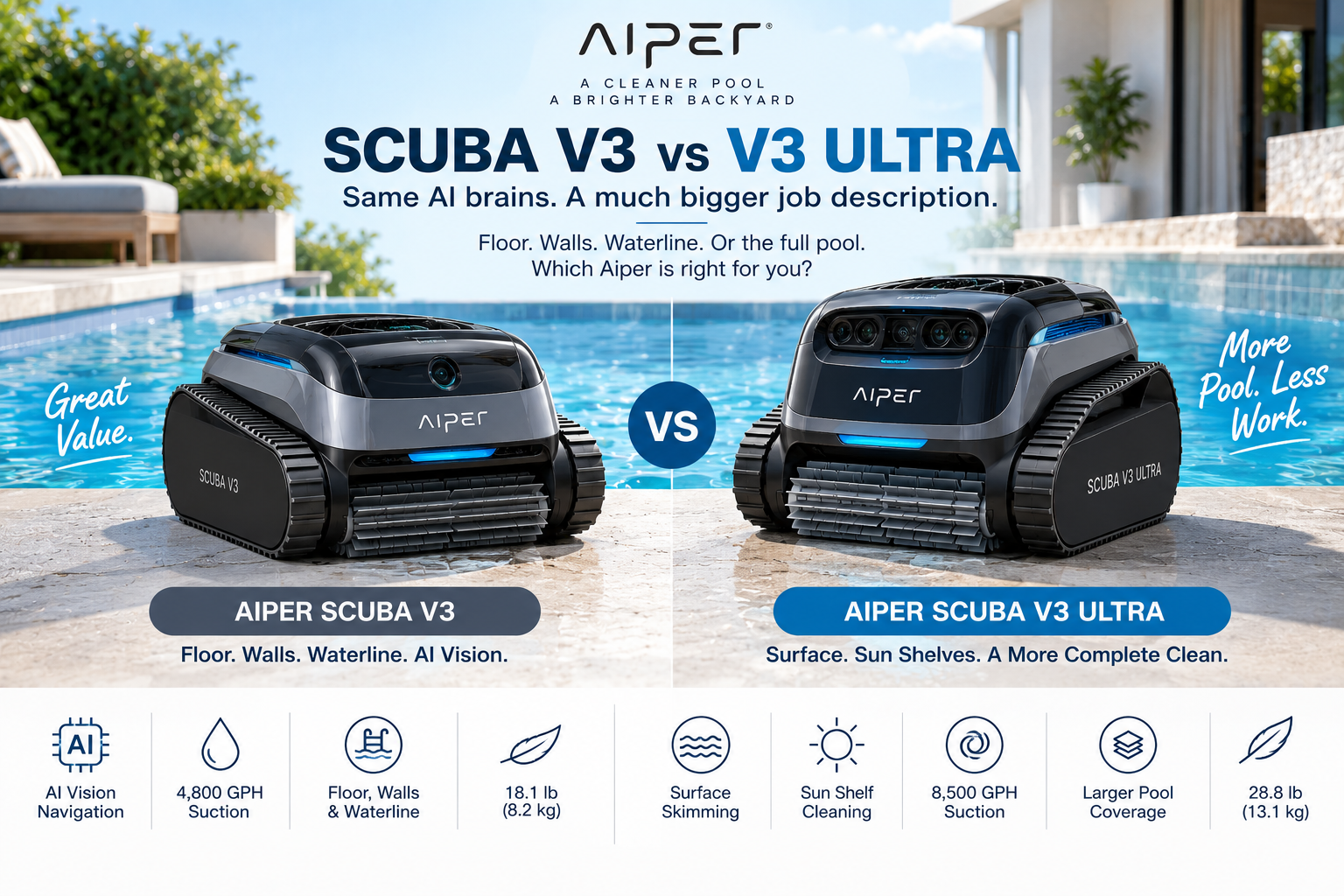
Short answer: Start with the Scuba V3 when its rated 1,614-sq-ft pool size and floor, wall and waterline cleaning fit your needs. Consider the Scuba V3 Ultra for its additional advertised capabilities — surface skimming, shallow tanning-ledge/sun-shelf cleaning, a much larger rated pool size and automatic surface retrieval — not simply because it has higher specification numbers. Don’t buy the Ultra primarily on an assumption of excellent surface skimming: PCWorld reported weak real-world skimming results in its June 2026 test.
- Floor + walls + waterline: Scuba V3
- Sun shelf/tanning ledge + very large pool (not skimming alone): Scuba V3 Ultra
Check the live price before deciding: Aiper’s US storefront listed the V3 at $849.99 and the Ultra at $1,899.99 as of September 7, 2026 — a $1,050 gap. Those are Aiper’s direct-storefront prices excluding additional discounts, tax or shipping, not verified Amazon prices. That gap makes the Ultra’s extra pool zones, not a spec-sheet victory, the real buying question.
How we assessed these models: This is a specifications comparison based on Aiper’s published documentation, not a claim that we personally tested either machine. Prices, availability and promotions can change.
Aiper Scuba V3 vs V3 Ultra: At a Glance
| Feature | Scuba V3 → | Scuba V3 Ultra → |
|---|---|---|
| Storefront price | $849.99* | $1,899.99* |
| AI vision | Single front camera | Dual-camera AI |
| Additional sensing | dToF/navigation sensors | Dual cameras + ultrasonic sensors |
| Floor cleaning | Yes | Yes |
| Wall cleaning | Yes | Yes |
| Waterline cleaning | Yes | Yes |
| Surface skimming | No | Advertised — see testing caveat below |
| Shallow sun-shelf cleaning | No dedicated capability | Advertised down to ~7.9 in |
| Flow rating | ~4,800 GPH | ~8,500 GPH |
| Fine filtration | MicroMesh | MicroMesh |
| Rated pool size | 1,614 sq ft | 3,875 sq ft |
| Automatic retrieval | Waterline parking | Automatic surface retrieval/JellyFloat |
| Weight (dry, listed) | ~18 lb | ~29 lb |
| Best for | Most conventional pools | Large/complex pools needing full-zone cleaning |
Specifications are Aiper’s manufacturer ratings, not OriginSelect-tested results. * Storefront prices checked September 7, 2026, excluding additional discounts, tax or shipping; not verified Amazon prices — check Amazon.com for the live price. Listed weights are dry manufacturer figures, not a measured wet lifting load; Aiper’s own marketing and storefront pages show slightly different V3 weights (18.1 vs 18.2 lb), rounded here to ~18 lb.
The $1,000 Question: Do You Actually Need Surface and Sun-Shelf Cleaning?
Both machines already handle the core underwater cleaning jobs — floor, walls and waterline. A buyer shouldn’t pay an additional $1,000 or more simply for a second camera, a higher model number, or “more AI.” The real Ultra upgrades are physical jobs the V3 doesn’t perform.
Surface skimming: Floating leaves, insects and other debris can be collected before they sink — that’s Aiper’s advertised capability. This may be valuable for pools surrounded by trees, landscaping, or frequent wind-blown debris. But a buyer who already owns a separate solar skimmer may have less reason to pay for this capability, and independent testing (below) found the Ultra’s real-world skimming weaker than the spec sheet suggests — don’t buy the Ultra primarily on an assumption of excellent surface skimming.
Sun shelves / tanning ledges: If the pool has a large Baja shelf or tanning ledge, ordinary robots can struggle with the transition into very shallow water. Aiper specifically advertises the Ultra for shallow areas down to approximately 7.9 inches. That’s a real functional reason to upgrade — but a minimum-depth spec doesn’t guarantee it will maneuver every step, shelf or ledge shape, and a pool without these shallow features can’t extract much value from it.
AI Camera: One vs Two
V3: Uses a single front-facing AI camera. Aiper says it can identify 20+ debris types, target visible debris, and work with VisionPath/dToF navigation to adapt cleaning routes.
V3 Ultra: Uses dual cameras plus ultrasonic sensors. The dual-camera configuration gives the system greater spatial and depth awareness and supports more complex operating modes, including a roughly 6.6-ft detection range and 10 adaptive cleaning paths.
OriginSelect take: the Ultra’s dual-camera system matters most because it supports a more complex robot capable of surface and shallow-zone operation. Someone buying solely for ordinary floor cleaning shouldn’t spend $1,000+ just to move from one AI camera to two.
Flow Rating: 4,800 vs 8,500 GPH
The Ultra is intended to handle a broader range of debris and operating zones and has much greater manufacturer-advertised water-flow capacity: roughly 8,500 GPH versus roughly 4,800 GPH for the regular V3. GPH is an advertised flow rating, not a suction-pressure measurement or independently measured pickup performance. The specification gives the Ultra considerably more raw cleaning capacity, which becomes more relevant in large pools or heavy leaf/debris conditions — but the ratio between the two numbers isn’t a percentage improvement in real-world cleaning that OriginSelect has verified.
The V3 Is Much Easier to Lift
This is an underappreciated difference. The regular V3 weighs approximately 18 lb dry-listed (Aiper’s own marketing and storefront pages show slightly different figures, 18.1 vs 18.2 lb); the Ultra weighs approximately 29 lb dry-listed — roughly 11 lb heavier, not a precise measured gap. Dry listed weight also isn’t the same as a measured wet lifting load: pool robots can feel heavier when being lifted because water needs to drain, and the Ultra’s automatic surface retrieval and quick drainage help, but it remains physically much larger. For buyers who expect to retrieve the robot frequently or simply prioritize easy handling, the regular V3’s lower weight is a meaningful advantage.
Large Pools
The regular V3 is rated for pools up to 1,614 sq ft. The Ultra is rated for up to 3,875 sq ft. The Ultra becomes easier to justify when your actual pool surface substantially exceeds the V3’s rated size — not merely as “future-proofing” for a small pool.
Retrieval
The V3 provides smart waterline parking and an app notification when it’s ready for retrieval — it doesn’t simply sit at the bottom of the pool. The Ultra goes a step further: its JellyFloat buoyancy system can bring the robot to the surface automatically for retrieval. Retrieving a heavy pool cleaner from deep water with a hook can be annoying, so the Ultra’s surface-retrieval system is a genuine convenience advantage — particularly given its extra weight.
What About Surface Skimming?
The Ultra can function as both an underwater cleaner and a surface skimmer. That’s attractive because pool owners normally run a separate underwater robot plus a dedicated surface skimmer. But there’s a real purchasing alternative: a regular V3 plus a dedicated solar surface skimmer.
Ultra integrated approach — pros: one device, surface and underwater cleaning together, one ecosystem, fewer devices around the pool.
Separate-device approach — pros: a dedicated skimmer can operate independently, and you don’t have to spend Ultra-level money if the regular V3 already handles your underwater cleaning needs. OriginSelect hasn’t tested either approach head-to-head, so we won’t claim one performs better than the other.
What Independent Testing Says About the V3 Ultra
These are named, dated reviews from individual testers, not an OriginSelect test and not a controlled V3-versus-Ultra head-to-head.
PCWorld (Christopher Null, June 19, 2026, testing the Ultra): reported effective underwater debris targeting, but its default three-hour skimming run collected under half of the reviewer’s scattered test leaves, and task-failure messages also occurred. That’s one review’s result on one unit, not proof every Ultra behaves identically.
BobVila.com (Paul Rankin, May 17, 2026, testing the regular V3): about a month of use in a screened-in Florida in-ground pool — mainly sand, bugs and algae — produced favorable observations about targeting debris and retrieval. That setting matters: it wasn’t an unscreened heavy-leaf test or a controlled comparison against the Ultra.
WIRED (Christopher Null, March 21, 2026, testing the regular V3): liked the underwater cleaning but criticized parts of the app/scheduling experience and described a limited retrieval window. The same reviewer wrote both this WIRED V3 review and the PCWorld Ultra review above — one tester’s two separate write-ups, not two independent confirmations of anything.
Taken together, this reinforces our existing recommendation: buy the V3 Ultra only if its extra advertised operating zones—especially surface skimming and shallow shelf cleaning—solve a real problem in your pool, and don’t assume excellent surface skimming going in. For most conventional pools, the regular V3 remains the safer value choice.
Who Should Buy Scuba V3?
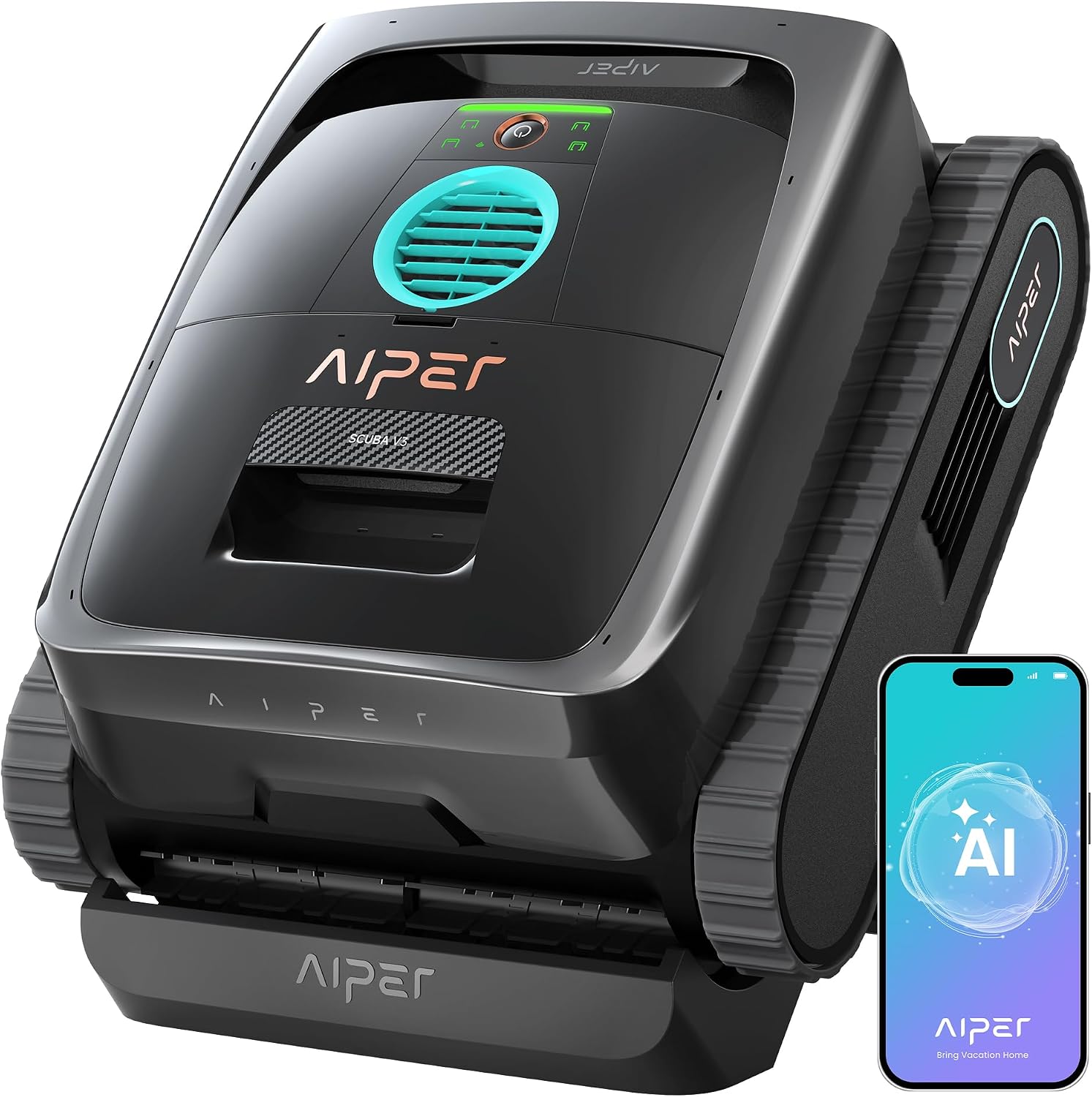
Buy the Scuba V3 if your pool is approximately ≤1,614 sq ft, your main needs are floor, wall and waterline cleaning, your pool has no meaningful tanning ledge/sun-shelf requirement, surface debris is manageable separately, lighter weight matters, and spending $849.99 rather than $1,899.99 (Aiper’s US storefront, checked September 7, 2026) matters. Main reason to skip: you specifically need the Ultra’s surface/shallow-area capability or have a much larger pool.
Check Scuba V3 price on Amazon
Who Should Buy Scuba V3 Ultra?
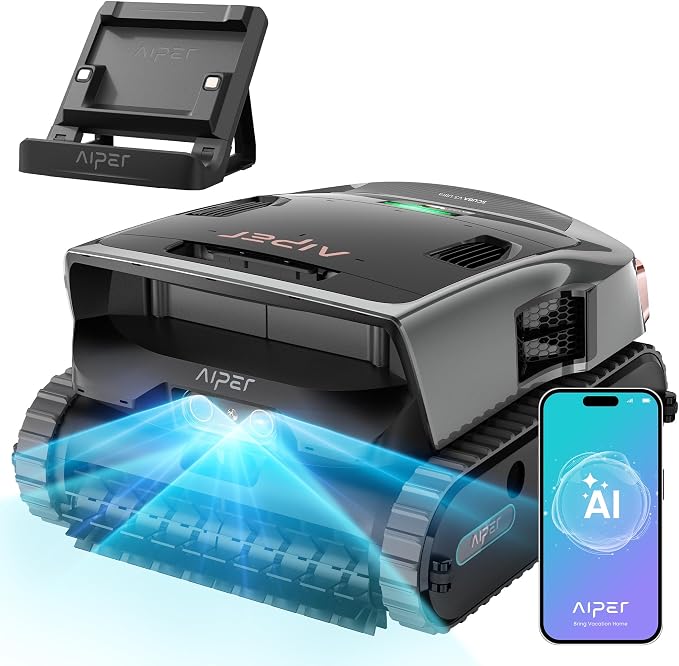
The Ultra becomes easier to justify when you need shallow sun-shelf cleaning, much larger pool coverage, stronger advertised flow capacity or automatic surface retrieval. Surface skimming is also one of its headline features, but PCWorld’s June 2026 test found real-world skimming performance weaker than advertised, so we would not buy the Ultra for that capability alone.
Buy V3 Ultra if you have a large pool, heavy floating leaves/debris are a constant problem, you want built-in surface skimming (see the testing caveat above), your pool has a tanning ledge/Baja shelf, shallow-area cleaning matters, the stronger 8,500-GPH advertised flow rating is useful, automatic surface retrieval matters, or paying the roughly $1,050 storefront premium replaces other maintenance work/devices you’d otherwise need. Main reason to skip: you’d be paying for pool zones/features your pool doesn’t have.
Check Scuba V3 Ultra price on Amazon
Should Existing V3 Owners Upgrade?
Usually no. A working V3 is already a 2026 AI-vision pool robot. Upgrade only if ownership reveals a specific missing capability: constant surface debris, a tanning ledge not being cleaned, a pool that substantially exceeds the V3’s practical coverage, a frustrating retrieval workflow, or a desire to consolidate surface and underwater cleaning into one machine. Don’t replace it merely because the Ultra is the flagship.
What If They Cost Different Amounts on Amazon?
Prices can move substantially. If the Ultra costs more than twice as much, V3 is the default recommendation unless surface/sun-shelf capability solves a real problem. If the Ultra premium narrows substantially, the integrated skimmer, larger coverage and shallow cleaning become easier to justify. If V3 is heavily discounted, it becomes especially compelling for conventional pools.
Frequently Asked Questions
What is the difference between Aiper Scuba V3 and V3 Ultra?
Both use AI vision and clean pool floors, walls and waterlines. V3 Ultra adds dual-camera vision, ultrasonic sensing, a substantially higher 8,500-GPH advertised flow rating, advertised surface skimming, shallow sun-shelf cleaning, a larger rated pool size and JellyFloat automatic surface retrieval. Independent testing found the Ultra’s real-world surface skimming weaker than advertised — see the testing section for details.
Does Scuba V3 clean the pool surface?
The regular Scuba V3 is designed primarily for floor, wall and waterline cleaning. The V3 Ultra adds surface-skimming capability.
Does Scuba V3 Ultra clean tanning ledges?
Aiper specifies shallow-area cleaning down to approximately 7.9 inches / 20 cm for V3 Ultra, making tanning ledges and Baja shelves one of its most meaningful advantages.
Is Scuba V3 Ultra worth twice the price?
For many conventional pools, probably not. It becomes much easier to justify when the pool has heavy surface debris, a tanning ledge/shallow shelf, unusually large cleaning area, or when one-device surface and underwater cleaning is valuable — though PCWorld’s June 2026 test found real-world surface skimming weaker than advertised, so don’t buy it for skimming alone.
Which Aiper V3 is better for leaves?
V3 Ultra has a higher manufacturer-advertised 8,500-GPH flow rating and advertised surface-skimming for floating debris, though a June 2026 PCWorld test found real-world skimming weaker than advertised. It’s likely the more capable option for heavy leaf conditions, but OriginSelect has not independently tested pickup performance.
Is regular Scuba V3 still an AI pool robot?
Yes. It uses a front-facing AI camera, VisionPath navigation and Cognitive AI features. Ultra expands the sensing system rather than introducing AI from scratch.
Which is easier to lift?
The regular V3 is substantially lighter — approximately 18 lb dry-listed versus approximately 29 lb for the Ultra, roughly 11 lb heavier, not a precisely measured gap. Those are dry manufacturer weights, not a measured wet lifting load. The Ultra partly offsets its greater weight with automatic surfacing and quick drainage.
Should I upgrade from Scuba V3 to V3 Ultra?
Usually not unless you specifically need surface skimming, shallow-zone cleaning, substantially larger pool coverage or the Ultra’s retrieval system.
Final Verdict
For most conventional in-ground pools, we’d buy the Scuba V3. It already brings Aiper’s 2026 AI vision, targeted debris cleaning, walls, waterline, fine filtration and convenient parking/retrieval at less than half the storefront cost of the Ultra ($849.99 vs $1,899.99 as of September 7, 2026). The Scuba V3 Ultra is not just a faster V3, though. Its real value is expanding the advertised jobs one robot can do: shallow sun-shelf cleaning, a much larger rated pool size and automatic surfacing. Don’t buy it primarily for surface skimming — PCWorld’s June 2026 test found that weaker than advertised. If the Ultra’s other advertised capabilities solve actual problems in your pool, the premium can make sense. If they don’t, save the money.
Sources & Methodology
This comparison combines Aiper’s US marketing and storefront pages with three named, dated independent reviews. OriginSelect has not tested these robots side by side, and the linked reviews describe their own individual test conditions — they are not a uniform head-to-head test by OriginSelect. Storefront prices, comparison-table figures and reviewer observations are dated below; page layouts, prices and stock can change afterward.
- Aiper US V3 marketing page (VisionPath/dToF, advertised cleaning roles, flow, weight, retrieval) — aiper.com
- Aiper US V3 storefront (standalone price, comparison table, weight, pool size) — aiper.store
- Aiper US Ultra marketing page (dual-camera/ultrasonic architecture, shallow-area claim, JellyFloat) — aiper.com
- Aiper US Ultra storefront (standalone price, comparison table) — aiper.store
- Christopher Null, PCWorld, June 19, 2026 — Ultra’s underwater results and skimming limitations — pcworld.com
- Paul Rankin, BobVila.com, May 17, 2026 — V3 in a screened Florida pool — bobvila.com
- Christopher Null, WIRED, March 21, 2026 — V3 cleaning, app and retrieval observations — wired.com